Build in Public Posts Ideas: A Weekly Rhythm
Build in public posts ideas that don't run dry: a weekly rhythm of mostly non-product posts, with formats, prompts and a table to plan them.
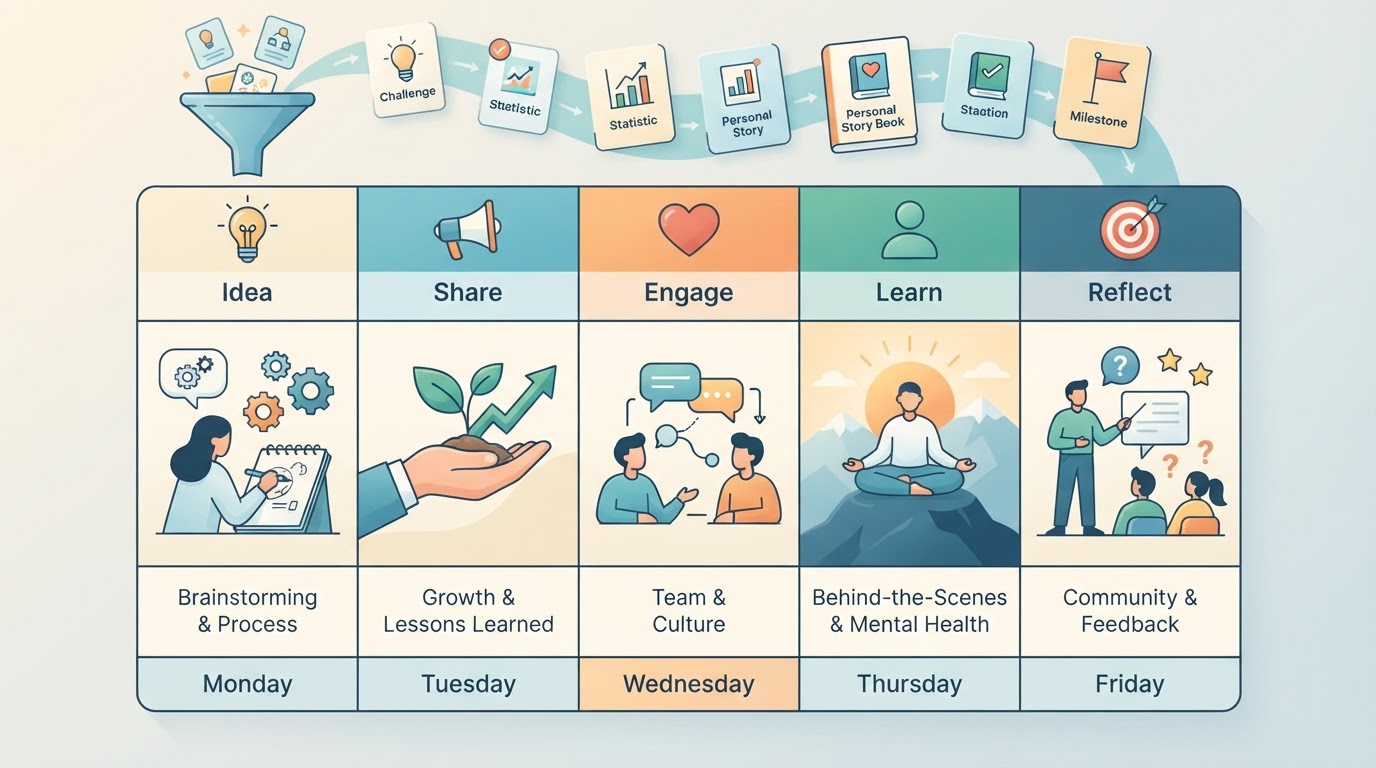
The best build in public posts ideas come from what you already did this week, not from a list of prompts. A merged pull request, a decision you reversed, a bug that ate three days, a customer question you couldn't answer: each one is a post. The problem most founders hit isn't a shortage of material. It's that they only know how to frame one kind of material, the launch, and then they go quiet for two weeks.
Most of the lists ranking for this keyword give you 27 ideas and stop there. What they leave out is the part that actually keeps you posting: a rhythm, and a rule for what counts as a post. This is how I'd run it.
What makes a build in public post work?
A post works when it has a real moment, an angle that matters to someone other than you, and one concrete takeaway. The moment is the raw material. The angle is why a stranger should care. The takeaway is the sentence they'd repeat to a friend.
A weekly shipping recap with no angle is a diary entry. The same recap with one line about what surprised you is a post. Same facts, different framing.
What are some good ideas for social media posts?
Steal from the week you just had. Here are formats that hold up, grouped by what they're made of.
Progress posts
- The weekly recap: what shipped, what took longer than expected, what's next.
- Before and after: the old screen next to the new one, one sentence on what changed.
- The invisible work post: the migration, the cleanup, the thing nobody sees but everything depends on.
- The end-of-day log: what you touched, what blocked you, what you learned.
Decision posts
- Why you built X instead of Y.
- The feature you decided not to build. This one usually outperforms launch posts because it shows judgment.
- The pricing decision: trial length, monthly vs annual, early access.
- The "we were wrong" post: a decision you reversed and what changed your mind.
Failure posts
- The experiment that didn't work.
- The bug that ate three days.
- The launch that flopped, with what you expected and what happened.
- The process you deleted. Removing a workflow is a win worth posting.
Numbers posts
- One metric, one chart, one annotation on what caused the change.
- A conversion improvement: what changed, why, what happened.
- A usage pattern that surprised you.
- A waitlist or demand signal, useful before you have revenue to share.
Audience posts
- A belief about your space that shapes how you build.
- The customer problem story, told as pain rather than feature.
- The ask post: two directions, pick one.
- A tool or template you now rely on.
Can you give me 10 content ideas?
Yes, and they're all non-product. This is the part most founders skip, and it's why their feed reads like a changelog.
- A question a user asked that you couldn't answer well.
- A tool you switched to and why.
- Something you read this week that changed your mind.
- A mistake in your onboarding you only noticed from a support thread.
- A decision you're still unsure about, posted as an open question.
- The thing you'd tell a founder starting the same week you did.
- A screenshot of your own planning doc, with the messy parts left in.
- A comparison of two approaches you tried, with the tradeoff spelled out.
- A short reflection on what you got wrong about your market.
- A reply to someone else's post that deserved more than a reply.
Notice how few of these mention the product. That's deliberate. A feed that's all product updates trains people to scroll past you. A feed that's mostly thinking, with the occasional ship, keeps them reading.
What are some good ideas for marketing posts?
Marketing posts are the ones that make the work visible to people who aren't already following you. Three formats do most of the work:
- The teardown: take a public page, a competitor's pricing, a landing headline, and explain what you'd change and why.
- The lesson from a number: one metric, the story behind it, no vanity framing.
- The build log with a hook: the same recap, but the first line leads with the good stuff, not "week 14 update."
If you want a rhythm rather than a pile of ideas, the useful unit is a week, not a post. Here's how one week of work turns into five posts:
| What happened this week | Angle | Post type |
|---|---|---|
| Shipped a feature | Progress | Weekly recap |
| Debated two paths | Decision | Why we built X instead of Y |
| Fixed a painful bug | Failure | The bug that ate three days |
| Saw a metric move | Numbers | One chart, one annotation |
| Read something useful | Audience | Resource or belief post |
One week, five posts, one of them about the product. That ratio is the whole trick.
What are some ideas for interactive Instagram posts?
Instagram rewards a different shape than X or LinkedIn, so the interactive formats are worth naming separately:
- A poll: two directions, two features, two headlines. Let people pick.
- A question sticker: "what's the one thing you'd fix in your onboarding?"
- A carousel that walks through one decision, one slide per step.
- A before and after in a single image, with the change written on it.
- A story series over a day: morning plan, midday blocker, evening result.
The rule that carries over from X: ask about something you're actually deciding, not a generic "what do you think?" People answer real questions and ignore fake ones.
How do you keep the rhythm going?
Two things make the difference between a habit and a burst that dies in week three.
First, keep the raw material somewhere it survives. The reason most founders stop is that the interesting details live in a session that ended: who replied, what you tried, why you dropped an idea. If that state isn't written down, the post never gets written. Outcry keeps that kind of state in Postgres so a later session can pick it up, which is the same reason a running doc beats memory.
Second, let the agent do the boring part. Outcry turns merged work into drafted X posts, and the drafts wait for approval unless you turn on automatic sending. You still write the angle. You just don't start from a blank box.
The part most lists skip
Every list of build in public posts ideas gives you formats. Almost none tell you what to do when the week was boring, which is most weeks. The answer is that boring weeks still contain a decision, a bug, or a question from a user. You're not short on material. You're short on the habit of noticing it.
Pick one format from each group above, put them in a rotation, and post the one that fits the week you actually had. That's a rhythm you can keep past week three.