Link Building for SaaS: Where Your First 20 Links Come From
Link building for SaaS, from a merged pull request to a sent email. How to find pages with a reason to link, and why most first attempts fail.
Link building for SaaS works differently from other niches: your best link sources are the pages that already compare, review or integrate with software like yours, and outreach only lands when you name a specific page and a specific reason it should link to you. Most early SaaS teams skip that and pitch generic guest posts, which is why their reply rate sits near zero.
This covers the parts the agency listicles skip: how to find pages that have a reason to link to you, how to qualify them, and what to actually write in the email.
What does link building mean in SEO?
Link building is the work of getting other websites to link to yours. In SEO terms those links are votes: Google and, now, AI assistants like ChatGPT and Gemini use them as signals that your site is worth citing.
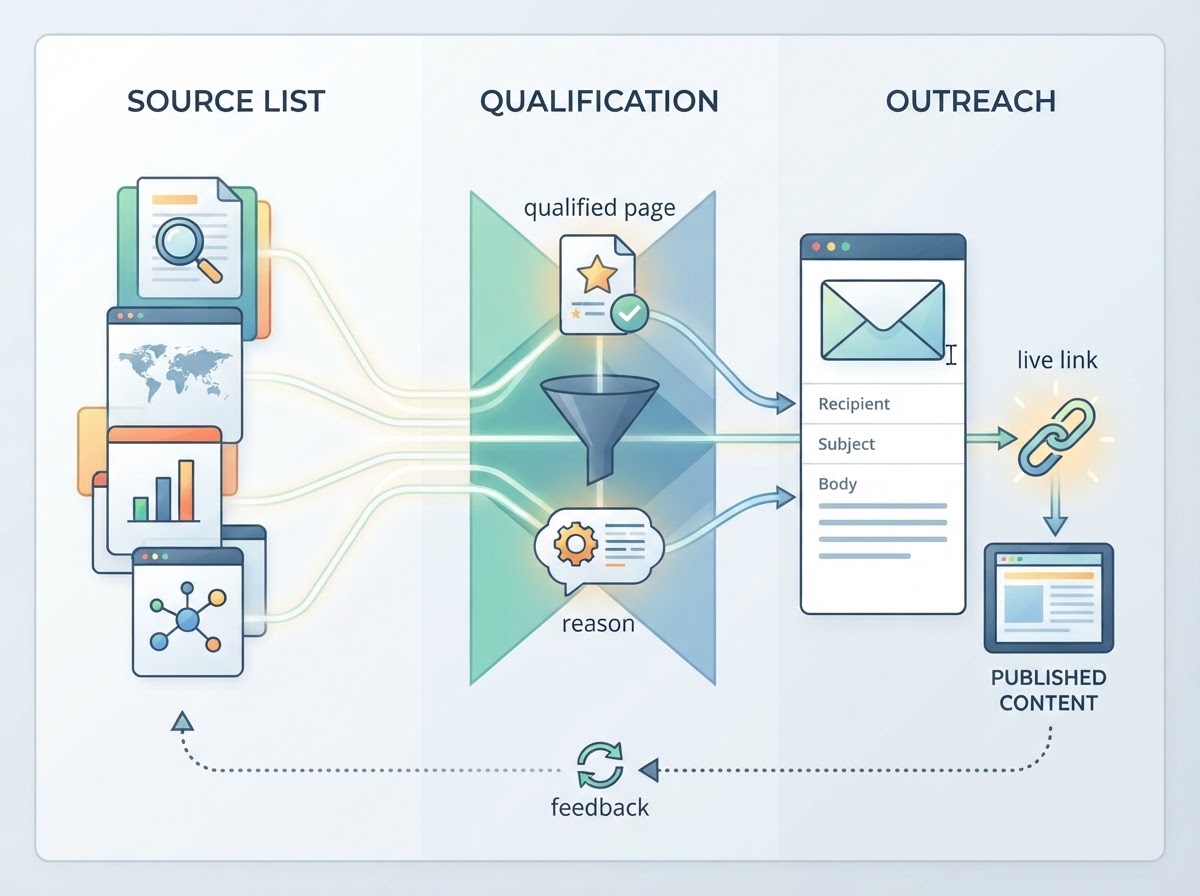
The part most guides get wrong is the direction of the work. It isn't a list of sites you want links from. It's a list of pages that have a reason to add a link to you right now: a comparison page missing your product, a docs page covering a problem you solve, a blog post about an approach you shipped.
If you can't name the page and the reason in one sentence, there's nothing to send. That rule alone will save you weeks.
Are backlinks still relevant in 2026?
Yes, and they matter for AI answers too. When an assistant summarises a category, it draws on the sources that get linked and cited around that topic. A brand nobody links to is a brand the model has less reason to name.
What changed is the bar. Directory dumps, paid link farms and guest-post networks still technically produce links, but they don't produce the mentions that make an AI tool list you alongside the competitors it already knows.
A practical test: would a person reading the page care that your link is there? If the only reader who benefits is Google, the link is worth less than the hour it took.
What are real link building strategies for a SaaS with no audience?
Your product ships. That's the asset. Here's what to do with it.
1. Start with merged work, not with a prospecting tool
Every meaningful release is a reason to contact someone. New integration, new API, new feature that solves a known complaint in your category. Write down what shipped this month in plain sentences. That list is your outreach material.
This is exactly the workflow Outcry is built around: your coding agent reports what changed, and Outcry turns it into drafts and outreach with a named target page and reason.
2. Build the list by counterparty type
Sort the sites you find into groups rather than one big pile:
- Media: sites that cover your category and would treat a release as news
- Adjacent: tools your users also use, not competitors
- Competitors: comparison and alternatives pages, handle carefully
- Providers: platforms you integrate with or build on
- Farms: content sites that will link for money, skip them
The group tells you the angle. A competitor comparison page needs a different email than a media outlet.
3. Qualify before you write
A prospect is qualified when you can name the target page and the reason in one sentence. "They're big in SaaS" is not a reason. "Their integrations page lists every tool that connects to X and we just shipped that" is.
This is where most early outreach dies. One named failure from Outcry's own internal September 2026 testing of two outreach tools against perspectiv.ink: one tool pitched a site that was already linking to the product. Before you send anything, check whether the link already exists.
4. Send from your own mailbox
Cold outreach sent from a shared sending domain lands in spam because the domain has no reputation. Send from your own Gmail or SMTP address, one that has history, and keep volumes low at the start. Ten new sites a day is plenty for a founder.
5. Check whether the link actually went live
Most guides stop at the reply. Track whether the page was published, whether the link is followed, and whether it still exists three months later. A won link that quietly disappeared is not a won link.
How much does link building cost?
There are three honest price points in 2026:
| Route | Typical cost | What you get |
|---|---|---|
| Founder does it | $0 plus 3 to 5 hours a week | Lowest ceiling, best learning |
| Tooling | $50 to $300 a month | Prospect lists, drafts, tracking |
| Agency | Retainers priced per link or per campaign | Managed placements, quality varies a lot |
Agencies quote per link, per month or per campaign, and most want a three to six month commitment. If you're pre-revenue, the founder route is usually the right one: you learn which angle gets replies, and that knowledge is what you'd be paying an agency to reinvent anyway.
One more thing to budget for: the cost of a bad link. A placement on a link farm can drag a young domain further than it lifts.
What are the top link building services for SaaS?
If you do hire, here's roughly what the well-known options cover. This is not a ranking, and pricing moves.
| Provider type | What they do | Watch for |
|---|---|---|
| Specialist SaaS agencies | Editorial placements on software and B2B sites, often with vetting checklists | Premium pricing; many have waitlists |
| Generalist SEO agencies | Broad link building plus content | Less niche knowledge, wider quality range |
| Marketplace and per-link vendors | Placements sold individually | Often the exact farms good agencies screen out |
| Tools (this category) | Find prospects, draft and track outreach you send yourself | You still do the sending and the judgment |
Ask any agency two questions before paying: can you show the actual pages you'd target, and how do you decide a site is legitimate? If the answer is domain rating alone, that's the same mistake the tools make.
The part most SaaS link building guides leave out
Everything above assumes you know what shipped and why. For a solo founder, that knowledge usually lives in a coding agent session that ends and takes the context with it. Who was contacted, who replied, who was rejected and why: gone.
Keeping that state somewhere durable is the difference between outreach as a one-off push and outreach as a system. Your agent can research prospects and write good emails. It just can't remember them tomorrow unless something stores the memory.
Outcry keeps that state and drafts from your merged work, grouping tools as Hear, Write and Reach. It's an early prototype, waitlist only, with no free tier. Worth knowing before you click.
Start with one release from this month and one page that has a reason to mention it. Send that email today.